WD38000 Series

WD38000 SERIES ROUTERS

The WD38000 Core Router Series is a next-generation routing solution designed for service provider-level applications. It is suitable for deployment as a backbone router, metropolitan area network (MAN) core node, and data center backbone interconnection node. The series is designed to support high-capacity network infrastructure and meet the growing demands of modern communication networks.
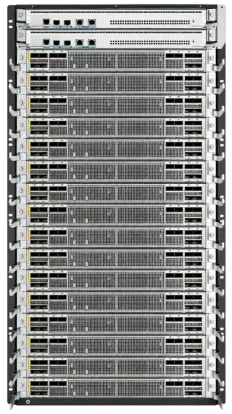
WD38000-8

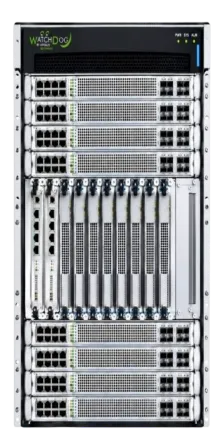
WD38000-8

  • Line-card slots: 8
  • Interface Buffer: 250 ms
  • Dimensions: 19 RU
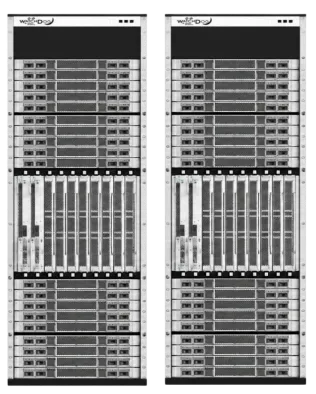
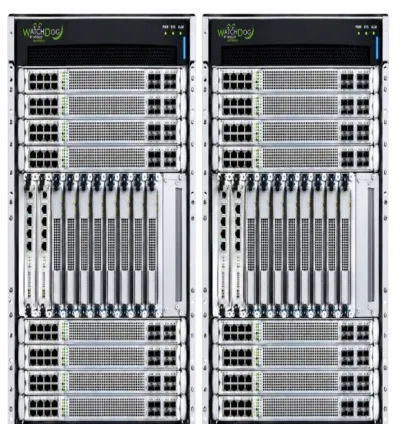
WD38000-8 back-to-back cluster

WD38000-8 back-to-back cluster

  • Line-card slots:16
  • Interface Buffer: 250 ms
  • Dimensions: 19 RU
WD38000-16

WD38000-16

  • Line-card slots: 16
  • Interface Buffer: 250 ms
  • Dimensions: 21 RU
WD38000-20

WD38000-20

  • Line-card slots: 20
  • Interface Buffer: 250 ms
  • Dimension: 41 RU
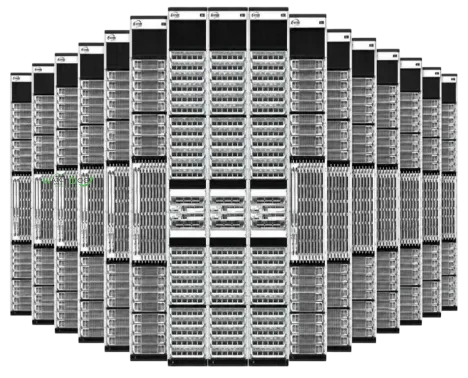
WD38000-20 3+12 cluster

WD38000-20 3+12 cluster

  • Line-card slots: 240
  • Interface Buffer: 250 ms
  • Dimension: 41 RU

Key Features

Advanced Switching Architecture and High Performance

The WD38000 Core Router Series adopts a fourth-generation, non-blocking CLOS switching architecture to enable high-speed data transmission with low latency. Its variable-length cell switching technology improves switching efficiency and optimizes overall cluster performance, making it suitable for high-capacity core network applications.

  • High Slot Capacity: Each service slot provides a switching capacity of up to 1,800 Gbps, enabling efficient handling of high-volume network traffic.
  • High-Density 100G Connectivity: Each port supports a capacity of up to 400 Gbps. The router supports up to 360 100G ports, with further capacity expansion possible according to the platform configuration.
  • Flexible Cluster Deployment: The WD38000 supports multiple clustering configurations, including back-to-back, 2+6, and 3+12 modes, enabling flexible deployment according to network scale and capacity requirements.
  • Multi-Chassis Scalability: The series supports cascading of up to 12 chassis, allowing network capacity to be expanded as demand increases.
  • Seamless Network Expansion: The architecture supports expansion from a single chassis to a clustered configuration, helping minimize infrastructure replacement requirements and protect existing investments.
Open Architecture and SDN-Oriented Design

The WD38000 Core Router Series adopts an open architecture and SDN-oriented design to support flexible network management and intelligent resource allocation. It provides multiple protocol interfaces for integration with external systems and supports communication with SDN controllers, enabling centralized network management and coordinated control.

Environment Friendly

Compliant with the RoHS standard. It features an advanced air-aisle design to improve space efficiency and ensure better airflow management.

High Security

The router employs a comprehensive set of advanced security features to ensure robust network protection. It supports rich security rules, including filtering based on five-tuple parameters, ASPF state, MAC addresses, URLs, domain-based firewall policies, and intrusion prevention system rules. The router also offers diversified VPN technologies such as IPsec, L2TP, GRE, ADVPN, and MPLS VPN, as well as flexible combinations of multiple VPN technologies to meet different deployment requirements. For endpoint access security, it provides strict access control through 802.1X and portal authentication, endpoint admission defense solutions, and endpoint MAC address authentication. Built-in DDoS protection safeguards the network against SYN, ACK, RST, and UDP flood attacks. Secure device management is achieved through role-based permission control, resource assignment based on roles, and user-to-role mapping.

Software

SOFTWARE SPECIFICATIONS

QinQ
  • VLAN termination
  • VXLAN
    Traffic statistics
    • Traffic statistics on both the incoming and outgoing traffic
    • Interconnect
      QoS
      • Queue scheduling
      • CAR (Ingress/Egress)
      • Dynamic modification of QoS policies
      • Priority marking/remarking
      • CBQ
      • Congestion management
      • QoS policy (applied on an interface, globally, and on the control plane)
      • QPPB
      ACL
      • Ingress/Egress ACL
      • Basic ACLs, advanced ACLs
      • Applying an ACL to an interface or globally
      IPv4 protocol
      • ICMPv4
      • DNS
      • TCP, UDP,
      • RawIP, Ping,
      • Traceroute
      • Telnet, FTP, TFTP
      • DHCP
      • NTP
      • ARP, ARP Proxy
      IPv6 protocol
      • Dual IPv4 and IPv6 protocol stacks
      • TCP6, UDP6, RawIP6, Pingv6,
      • Traceroute6
      • Telnetv6, FTPv6, TFTPv6
      • DNS6
      • ICMPv6
      • VRRPv3
      • DHCPv6
      • ND
      • PMTUD (IPv6)
      • 6PE
      IPv4 routing protocol
      • RIPv1/v2
      • OSPFv2
      • IS-IS
      • BGPv4
      • IPv4 static routing/routing policy/route recursion/policy-based routing
      IPv6 routing protocol
      • RIPng
      • OSPFv3
      • IS-IS6
      • BGPv4+
      • IPv6 static routing/routing policy/route recursion/policy-based routing
      Layer 3 multicast
      • IPv4 inter-AS multicast routes
      • IPv4 multicast group management
      • Static multicast routes
      • IPv4 intra-AS multicast routes
      • IPv6 intra-AS multicast routes
      • IPv6 multicast group management
      • Multicast VPN
      MPLS
      • Basic MPLS
      • MPLS L3VPN
      • MPLS TE
      • P2MP
      • VPWS/VPLS
      • 6VPE
      SDN
      • BGP-LS
      • BMP
      • PCEP
      • Flowspec
      • OpenFlow
      Segment Routing
      • SR BE、SR TE、SR TE Policy
      • SR OAM
      • L3VPN、EVPN
      • L3VPN HoVPN VPNv4/VPNv6 over SR BE/SR-TE/SR TE Policy
        SRv6
        • SRv6 BE
        • SRv6 TE Policy
        • SRv6 OAM
        • TI-LFA
        • L3VPN、EVPN L3VPN HoVPN VPNv4/VPNv6 over SRv6 BE/SRv6 TE Policy
        Device security
        • Protection against data packet-based attacks
        • Protection against protocol packet-based attacks
        • Attack detection
        • Protection of protocol packets
        • Diagnosis on packet transmitting and receiving
        Network security
        • Device management security
        • AAA
        • SSH
        • Packet filtering
        • Packet validity check
        • Protocol-based traffic limiting
        • NetStream
        • uRPF
        CLI management by accessing the device through
        • console port,
        • Telnet,
        • sTelnet (SSH)
        File management
        • Uploading/downloading files through FTP/TFTP
        • Formatting files
        • Creating, copying, deleting, saving files and directories
        Network maintenance
        • Ping
        • TraceRoute
        • LSP Ping/Tracert
        • Loop detection on a port
          Network management and monitoring
          • SNMPv3
          • IMC
          • LLDP
          • LLDP-MED
          • MIB
          • PTP
          High availability
          • Hot swapping of cards
          • Redundancy of switching fabric modules
          • Active/standby switchover
          • Hot patching
          • BFD for VRRP/BGP/IS-IS/RIP/OSPF/static routing
          • IP FRR
          • GR
          • NSR
          • VRRP, VRRPE
          Hardware

          Hardware Specifications

          Features WD38000-8 WD38000-8 back-to-back cluster WD38000-16 WD38000-20 WD38000-20 3+12 cluster
          MPU slots 2 NA 2 2 NA
          Switching fabric slots 6 NA 6 8 NA
          Line-card slots 8 16 16 20 240
          System aggregated throughput 14.4 Tbps 28.8 Tbps 28.8 Tbps 36 Tbps 432 Tbps
          FIBv4/ IPv4 Routes 4M (4 Million)
          FIBv6/ IPv6 Routes 2M (2 Million)
          IPv4 Routing Table (RIBv4) 40M IPv4 Routes
          IPv6 Routing Table (RIBv6) 30M IPv6 Routes
          ACL 120,000 IPv4 rules / 32,000 IPv6 rules
          Interface Buffer 250 ms (milliseconds)
          Ports 1000BASE-X-SFP fiber ports
          10GBASE-R/W-SFP+ fiber ports
          40GBASE-R-QSFP+ fiber ports
          100GBASE-R-QSFP28 fiber ports
          400GBASE-R-QSFPDD fiber ports
          Interfaces 1GE, 10GE, 40GE, 100GE and 400GE interfaces
          Power module 8 power modules per chassis support for redundancy and smart power management 16 power modules support for redundancy and smart power management 24 power modules per chassis support for redundancy and smart power management
          Fan trays 6 fan trays per chassis support for redundancy and smart heat dissipation 2 fan trays support for redundancy and smart heat dissipation 33 fan trays per chassis support for redundancy and smart heat dissipation
          Dimensions (H × W × D)
          Units: mm/Inch
          843 × 440 × 743 mm
          (33.19 × 17.32 × 29.25 in),
          19 RU
          931 × 440 × 857 mm
          (36.65 × 17.32 × 33.74 in),
          21 RU
          1820 × 440 × 850 mm
          (71.65 × 17.32 × 33.46 in),
          41 RU
          Operating Temperature -5°C to 55°C (23°F to 131°F)
          Operating Humidity 5% to 95%, non-condensing
          Operating altitude –60 m (–196.85 ft) to +5000 m (+16404.20 ft)