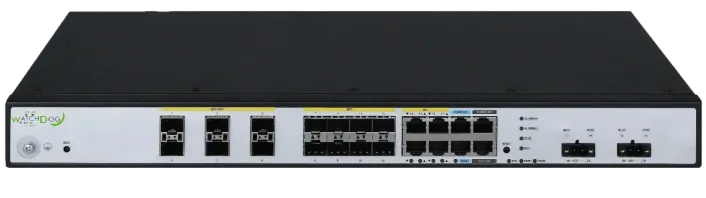
WD9100-G
- Switching capacity: 144Gbps
- Fixed Interface:6*10GE/GE+8*GEF/ FEF+4*GE

As the fifth-generation mobile communication network, 5G represents the evolution and expansion of the 4G mobile communication architecture, delivering transformative capabilities in speed, capacity, and responsiveness. The maximum downlink bandwidth can reach up to 10 Gbps, which is 50–100 times higher than that of 4G networks. This enables seamless transmission of high-resolution media such as 4K video and immersive VR content, making advanced applications
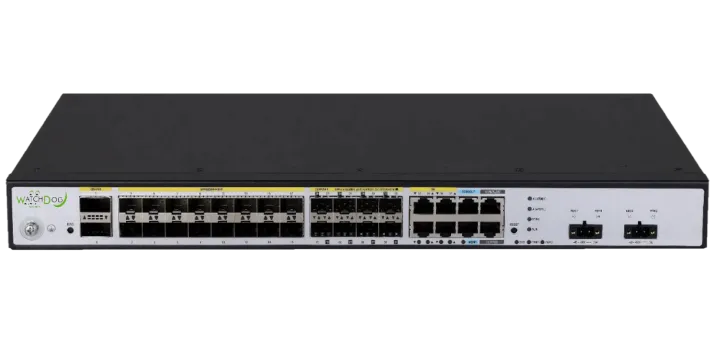
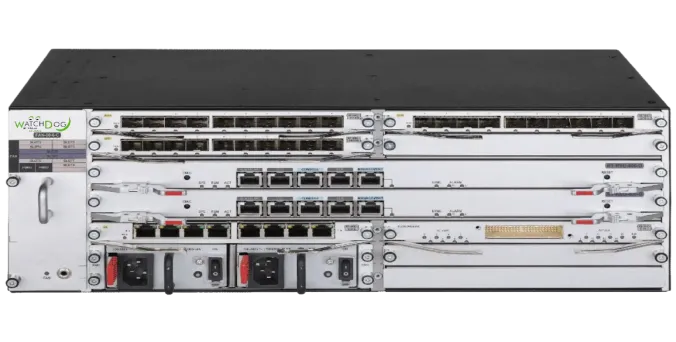
The WD9100 is designed with a dual master control architecture that ensures uninterrupted service during switching between the main and standby control units. The service boards support hot-plug capability, which enhances system reliability and allows maintenance without shutting down the device. The platform utilizes a non-blocking switching bus architecture combined with a professional integrated service processing engine, enabling support for up to 100G ring networking and line-rate service processing. It also provides flexible configuration by supporting multiple interface types such as GE, 10GE, 25GE, 50GE, and 100GE. In addition, the system uses a hardware coprocessor to accelerate protocol message processing for functions like clock synchronization, BFD, and OAM, delivering nanosecond-level clock accuracy and millisecond-level link fault detection. The device also supports 100G FlexE interfaces, which ensure service isolation, balanced load distribution, and flexible bandwidth adjustment.
The system is equipped with comprehensive reliability features to ensure continuous and stable network operation. It supports Bidirectional Forwarding Detection (BFD) for protocols such as ISIS, OSPF, BGP, PW, and LDP, enabling rapid detection and convergence in the event of network faults. The platform provides advanced reliability networking solutions by combining BFD fast detection with technologies such as Fast Reroute (FRR), Non-Stop Routing (NSR), and Graceful Restart (GR), enabling fault link switchover within approximately 50 milliseconds. Furthermore, it supports protection mechanisms including MPLS L2VPN FRR, MPLS L3VPN FRR, and OSPF/ISIS FRR for quick fault recovery. Additional service protection technologies such as Loop-Free Alternate (LFA), LSP (1:1) tunnel protection, and PW redundancy ensure millisecond-level service reliability. The device also includes high-precision error detection based on message verification, which can automatically trigger fast switching for interfaces, pseudo-wires, routing, and L3VPN services to maintain high service availability.
The WD9100 supports advanced Operations, Administration, and Maintenance (OAM) capabilities for efficient network monitoring and fault detection. It includes BFD-based OAM features that allow rapid detection of link failures and network issues.
The WD modular cloud network operating system is implemented to enhance operational performance, enabling faster routing convergence and improving overall system availability. The platform follows a business modularization design approach that allows loosely coupled service modules, making it easier to dynamically load, update, or upgrade system modules and patches without affecting other functions. Additionally, the platform supports modern network management and programmability protocols such as Telemetry, Netconf, YANG, and SNMP. These capabilities enable integration with Software-Defined Networking (SDN) environments and support scalable and automated network expansion. The system also supports multiple network performance and quality monitoring standards such as Y.1731, RFC2544, TWAMP Light, and Y.1564. By utilizing a hardware coprocessor to process detection protocol messages, the platform achieves millisecond-level detection accuracy. Additionally, the hardware coprocessor is responsible for sending and receiving detection traffic, ensuring high-performance monitoring capabilities across high-speed interfaces including 10GE, 25GE, 50GE, and 100GE links.
The device supports high-precision clock synchronization based on G.8275.1, enabling nanosecond-level time accuracy through the combined use of Synchronous Ethernet (SyncE) and Precision Time Protocol (PTP). SyncE provides reliable frequency synchronization and complies with the G.8262.1 performance requirements. The platform also supports PTP IEEE 1588v2, allowing precise time synchronization across network devices. To ensure stable clock distribution, the system implements the Best Master Clock (BMC) algorithm, which prevents clock loops and automatically selects and switches to the most reliable clock source. Additionally, the platform supports multiple clock roles, including Ordinary Clock (OC) and Boundary Clock (BC), enabling flexible deployment in time-sensitive networking environments
| Features | WD9100-G (DC/AC) | WD9100-G-HI (DC/AC) | WD9100 (DC/AC) |
|---|---|---|---|
| Forwarding Performance | 214Mpps | 590Mpps | 590Mpps |
| Switching Capacity | 144Gbps | 1.24Tbps | 1.6Tbps |
| Master Control | Centralized | Centralized | 1:1 redundancy |
| Fixed Interface | 6*10GE/GE+8*GEF/FEF+4*GE | 2*100GE/50GE+16*25GE/10GE/GE+8*GEF/FEF+4*GE+8*GEF (CSFP) | N/A |
| RIB v4/v6 | 1M/1M | 1M/1M | 1M/1M |
| FIB v4/v6 | 1M/1M | 1M/1M | 1M/1M |
| MAC | 96K | 96K | 96K |
| Reset Key | 1 | 1 | 1 |
| Interface Module Slot | N/A | N/A | AC: 7 / DC: 8 |
| Network Management Interface | 1GE/FE | 1GE/FE | 1GE/FE |
| ALMI/ALMO | 1 (RJ45, 3 in 1 out) | 1 (RJ45, 3 in 1 out) | 1 (RJ45, 3 in 1 out) |
| TOD | 1 (RJ45) | 1 (RJ45) | 1 (RJ45) |
| CLK | 1 (RJ45) | 1 (RJ45) | 1 (RJ45) |
| Redundant Power Supply | 1+1 redundancy | 1+1 redundancy | 1+1 redundancy (pluggable) |
| DC Power Supply | -48 ~ -60V | -48 ~ -60V | -48 ~ -60V |
| AC Power Supply | 100-240Vac, 50/60Hz, 3A or DC 240V/2A | 100-240Vac, 50/60Hz, 3A or DC 240V/2A | 200~240V/100-127VAC, dual live wire, 50/60Hz, 10-6A or DC 240V/5A |
| Fan Frame | 1 (fixed) | 1 (fixed) | 1 (pluggable) |
| Frame Height (U Height) | 1RU | 1RU | 3.5RU |
| Outward Size (W×D×H) | 440*205*44 mm | 440*205*44 mm | 440*220*163.5 mm |
| Aseismic Grade | level-8 | level-8 | level-8 |
| Operating Temperature | -5°C to 55°C | ||
| Operational Altitude | 5000m | ||
| Operating Humidity | 5~95% (non-condensing) | ||
| MTBF (Hours) | 620000 | 680000 | 700000 |