
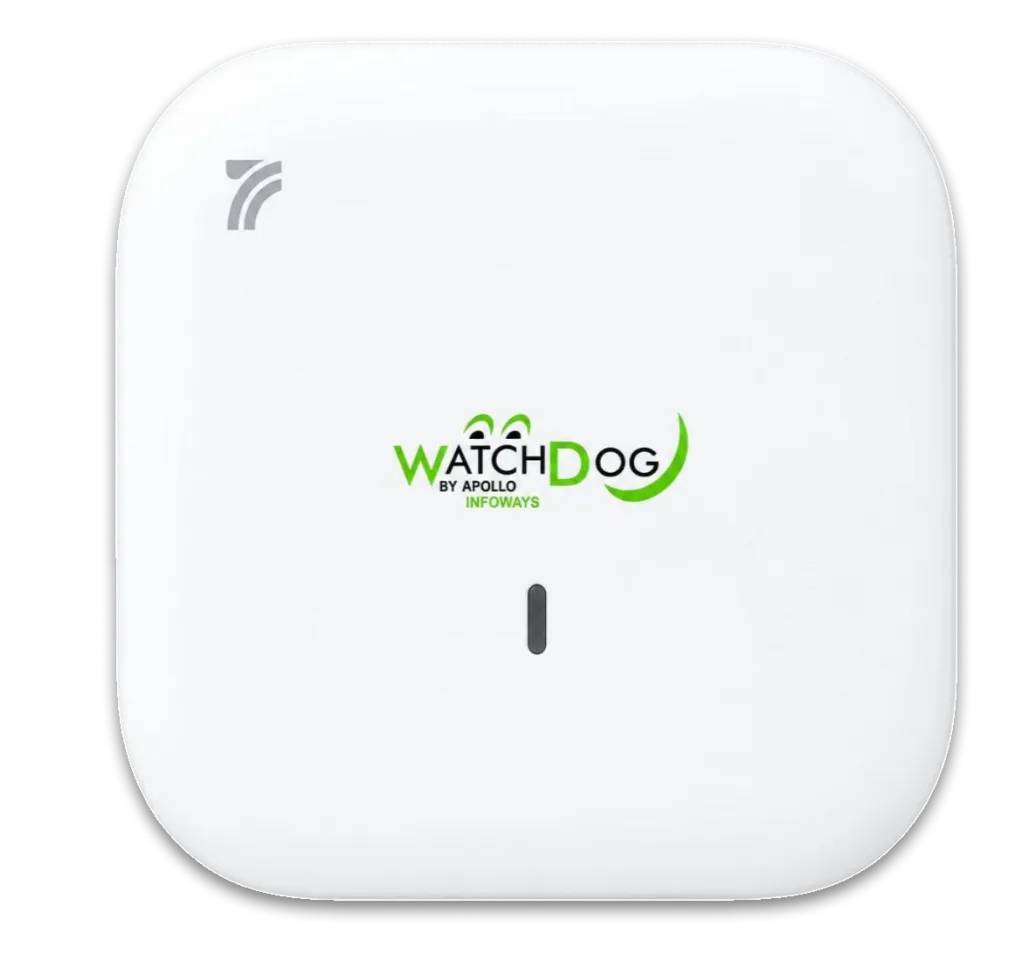
WD-AP1700
- Wi-Fi 7
- 18.4 Gbps Speed
- Tri-Radio + Scanning Radio
- 10G Ethernet & SFP+ Uplink
- AI RF Optimization
- Advanced Security (WPA3)
Key Features
Wi-Fi 7 AP with Powerful Capabilities
WatchDog Wi-Fi 7 Series Access Points (APs) are specifically designed for demanding users, corely delivering secure, highly resilient, and high-performance Wi-Fi connectivity—accurately meeting the rigorous wireless experience requirements of enterprise-grade scenarios. WatchDog Wi-Fi 7 series APs support three flexible AP modes (CloudAP, FitAP, AnchorAP), which can operate independently or work in collaboration with wireless controllers and also supports CWMP protocol. They can be freely switched according to actual deployment needs, adapting to different network architectures. Meanwhile, they are paired with WatchDog cloud-based deployment platform and WD-NMC on-premises deployment platform— both platforms are equipped with capabilities for intelligent automated management, AI-driven insights, and unified infrastructure management and control. Leveraging these two flexible deployment options, users can easily enable full-lifecycle management of Wi-Fi 7 APs, maximizing the efficiency of intelligent O&M (Operations and Maintenance). This thus ultimately meets the diverse application scenario needs of various enterprises.
Wi-Fi Advance Features
The device adopts a tri-radio architecture with 8 spatial streams, supporting 2×2 MIMO across the 2.4 GHz, 5 GHz, and 4x4 MIMO for 6 GHz bands. The 6 GHz band supports channel bandwidths of up to 320 MHz, enabling a maximum tri-band aggregated throughput of up to 18.4Gbps. The 6 GHz radio supports flexible mode switching. When reconfigured to the 5 GHz band, the access point can operate in dual 5 GHz mode, allowing higher client capacity and improved performance across diverse deployment scenarios. The access point is equipped with one 10GE electrical port and one 10G SFP+ optical port. The SFP+ port supports PoE input, enabling up to 400 meters of PoE+ (802.3at) power delivery over a hybrid copper-fiber cable. It integrates a Bluetooth module, PoE-out port, and USB interface, supporting IoT expansion and enabling flexible connectivity for a wide range of IoT applications. Additionally, AI-driven dynamic power-saving technology optimizes energy consumption, helping reduce operational costs while maintaining performance.
Wi-Fi 7 Standard
The IEEE 802.11be (Wi-Fi 7) standard represents the latest generation of wireless technology, introducing advanced features such as 4096-QAM modulation, Multi-Link Operation (MLO), enhanced OFDMA, and preamble puncturing, along with support for channel bandwidths up to 320 MHz. These innovations significantly improve throughput, efficiency, and spectrum utilization. Wi-Fi 6E extends Wi-Fi 6 into the 6 GHz band, while Wi-Fi 7 builds upon both Wi-Fi 6 and Wi-Fi 6E as a next- generation evolution. It enhances core capabilities by supporting wider 320 MHz channels, MLO for simultaneous multi-band communication, and 4096-QAM modulation, enabling substantially higher data rates and improved connection reliability. These advancements make Wi-Fi 7 particularly well-suited for latency-sensitive and high- bandwidth applications, such as AR/VR, ultra-HD streaming, and real-time collaboration.
SOFTWARE SPECIFICATIONS
Product Features
- Basic information
- Indoor, triple-radio AP, 802.11a/b/g/n/ac/ac Wave 2/ax/be
- AP Operating Mode
- Fit AP Mode, managed by Wireless LAN Controller
Cloud AP Mode, managed by WatchDog intelligent O&M platform
Anchor AP Mode, managed by Anchor AP Note: AP Operating Modes can be switched via CLI, Wireless LAN Controller, WatchDog intelligent O&M platform, Reset button - Frequency and MIMO
- Tri-radio mode (Default): 5GHz, 4×4:4, 5.765Gbps •
5GHz, 2×2:2, 2.882Gbps • 2.4GHz, 2×2:2,
0.688Gbps
Tri-radio mode: 6GHz, 4×4:4, 11.529Gbps • 5GHz, 2×2:2, 2.882Gbps • 2.4GHz, 2×2:2, 0.688Gbps
Tri-radio mode: 6GHz, 4×4:4, 11.529Gbps • 5GHz, 2×2:2, 2.882Gbps • 5GHz, 2×2:2, 2.882Gbps - Compliance and bandwidth
- 6GHz, 802.11ax/be: 20MHz/40MHz/80MHz/160MHz/320MHz
5GHz, 802.11a/n/ac/ax/be: 20MHz/40MHz/80MHz/160MHz
2.4GHz, 802.11b/g/n/ax/be: 20MHz/40MHz - Maximum transmission speed
- 18.4Gbps (4x4 320 MHz on 6 GHz, 2x2 160 MHz on 5 GHz, and 2x2 160 MHz on 5 GHz)
15.099Gbps (4x4 320 MHz on 6 GHz, 2x2 160 MHz on 5 GHz, and 2x2 40 MHz on 2.4 GHz)
9.335Gbps (4x4 160 MHz on 5 GHz, 2x2 160 MHz on 5 GHz, and 2x2 40 MHz on 2.4 GHz) - Maximum number of clients
- 1536 (512 on 6 GHz, 512 on 5 GHz, and 512 on 2.4 GHz) Note: the actual number of users varies according to the environment
- Maximum number of BSSIDs for each radio
- 16
802.11be
- 320MHz channel width
- The 6GHz frequency band is one of the core key technologies of Wi-Fi 7. With its ultra-large available bandwidth of 1200 MHz, it can support a configuration of up to 3x 320 MHz channels, accurately supporting low-latency and high-bandwidth-consuming application scenarios such as high-definition video and AR/VR. Furthermore, this frequency band is restricted to access by devices that support Wi-Fi 6E or Wi-Fi 7, effectively avoiding interference and speed loss caused by traditional Wi-Fi devices at the source
- 4096-QAM
- As one of the key technologies of Wi-Fi 7, 4096-QAM is a quadrature amplitude modulation (QAM) technology capable of carrying 12 bits of data per symbol. Under identical coding conditions, it delivers a 20% increase in data rate compared to the 1024-QAM used in Wi-Fi 6, laying a solid technical foundation for various high-bandwidth applications
- MLO
- Multilink operation (MLO) is a core technology in Wi-Fi 7 (802.11be) that enables devices to establish simultaneous connections across multiple frequency bands and channels (2.4 GHz, 5 GHz, 6 GHz) to achieve dramatically improved throughput, latency, and reliability
- Preamble puncturing
- Preamble puncturing is a key technology for Wi-Fi 7 to break through the limitations of spectrum resources. By dynamically eliminating interfered subchannels, it enables the efficient utilization of non-contiguous spectrum resources, significantly enhancing the network's anti-interference capability and spectrum utilization efficiency
- Multi-RU
- Multi-RU (Multi-Resource Unit) is a core physical-layer technology introduced in Wi-Fi 7. It enables the maximization of spectrum resource utilization through the dynamic aggregation of multiple Resource Units (RUs), addressing bandwidth bottlenecks and interference issues in high-density networks
- MU-MIMO
- Uplink / Downlink Multi-user multiple-input multiple-output (MU-MIMO)
- OFDMA
- Uplink / Downlink Orthogonal frequency division multiple access (OFDMA)
802.11ax
- TWT
- Target Wake Time, allowing clients to sleep for a predetermined period of time and be awakened only when network communication is needed, effectively reducing the power consumption
- BSS coloring/SR
- Spatial reuse, dividing different BSSs into different colors to avoid co-frequency interference and improve the user experience of wireless networks
- MU-MIMO
- Uplink / Downlink Multi-user multiple-input multiple-output (MU-MIMO)
- OFDMA
- Uplink / Downlink Orthogonal frequency division multiple access (OFDMA)
WLAN Basics
- A-MPDU
- Aggregated MAC Protocol Data Unit, improves the data transmission efficiency of wireless networks by optimizing the composition of TX/RX directional data packets
- A-MSDU
- Aggregated MAC Service Data Unit, improves the data transmission efficiency of wireless networks by optimizing the composition of TX/RX directional data packets
- LDPC
- Low-density Parity-Check, Improves the communication efficiency of wireless networks through error correction coding technology
- LACP
- Link Aggregation Control Protocol, achieving bandwidth aggregation, redundancy backup, and load balancing, the APs require at least 2 ports
- STBC
- Space-Time Block Coding, Improve the Channel capacity of wireless networks through multi-antenna coding technology
- DFS
- 802.11 Dynamic Frequency Selection, automatically identify DFS frequency bands, automatically adjust frequencies of the devices, and avoid interference with other devices
- TxBF
- Transmit Beamforming, Improve the signal-to-noise ratio of wireless network signal transmission by adjusting the beam direction of antenna transmitting signals
- CCF
- Cellular coexistence feature, use built-in software filtering to minimize the impact of interference from 3G/4G cellular networks
- MRC
- Maximum-ratio combining, improve signal reception quality
- CDD/CSD
- Cyclic Delay Diversity/Cyclic Shift Diversity, improve signal reception quality
Tunnel Management
- CAPWAP tunnel
- Unicast/broadcast/DNS/DHCP/static IP method for discovering AC
- DTLS
- Tunnel between AC and AP support DTLS encryption
- IPv4/IPv6
- Tunnel between AC and AP support IPv4 and IPv6
- Time synchronization
- Synchronizing clock information from AC
- Dual tunnel
- Establishing CAPWAP tunnels with two ACs
- PPPOE
- Support PPPOE Client
- IPsec
- Automatic channel/power/bandwidth adjustment
- RF adjustment
- Restrict access and improve wireless network security by SSID hiding
- SSID hiding
- Supports SSID/RF based
WLAN Extension
- F adjustment
- Automatic channel/power/bandwidth adjustment
- SSID hiding
- Restrict access and improve wireless network security by SSID hiding
- Limit the number of connected users
- User access count restriction based on SSID and RF
- Forwarding mode
- Local forwarding based on SSID and VLAN
- Local forwarding
- Supports interface/SSID/MAC binding VLAN based
- VLAN binding
- Binding VLAN based on interface/SSID/MAC
- User isolation
- VLAN-based user isolation, SSID-based user isolation
- Load balancing
- Traffic-based load balancing
User-based load balancing
Frequency band-based load balancing, dual-5G devices only - Band steering
- Help 6G capable clients migrate from 5G to 6G radios. Wi-Fi 6E and Wi-Fi 7 clients are automatically directed to the 6G radio to leverage its benefits, while freeing up 2.4G and 5G radios for legacy clients
- Roaming
- 802.11k and 802.11v smart roaming,
802.11r fast transition roaming - Multicast enhancement
- IPv4/IPv6 MLD Snooping/IGMP Snooping
Convert multicast data into unicast data for transmission, reducing network congestion - Wireless location
- Fit AP mode support BLE location
Fit AP mode support RSSI location - IOT
- IoT expansion by connecting third-party RFID or Zigbee gateways through PSE port
- Mesh
- Mesh link
Mesh link security
Multi-hop Mesh - Wireless probing
- Monitor the wireless network environment by monitoring wireless network messages
- Hotspot 2.0
- Fit AP mode support Hotspot 2.0
- Bonjour gateway
- Forwarding mDNS packets across VLANs
User Authentication
- 802.1X authentication
- Local and remote 802.1X authentication
- MAC authentication
- Local and remote MAC authentication
- Portal authentication
- Local and remote Portal authentication
Guest/Captive portal
Portal mac-trigger - PPSK
- Fit AP mode support Private Pre-Shared Key, obtain passwords to access wireless networks through WatchDog intelligent O&M platform
- Social Media APPs Authentication
- Cloud AP mode support Google/Facebook/Twitter through WatchDog intelligent O&M platform
- Extensible Authentication Protocol (EAP)
- EAP-Transport Layer Security (TLS)
EAP-Tunneled TLS (TTLS)
Microsoft Challenge Handshake Authentication Protocol (MSCHAP) v2
Protected EAP (PEAP) v0 or EAP-MSCHAP v2
EAP-Flexible Authentication via Secure Tunneling (EAP-FAST)
PEAP v1 or EAP-Generic Token Card (GTC)
EAP-Subscriber Identity Module (SIM)
Wireless Security
- Encryption
- TKIP, CCMP
WPA2-Personal (802.11i)
WPA2-Enterprise with 802.1X
WPA3-Personal, WPA3-Enterprise
WPA3-Enhanced Open (OWE)
Advanced Encryption Standard (AES) - Forwarding security
- Packet filtering
MAC address filtering
Broadcast storm suppression - Wireless EAD
- Coupled with EAD (End user Admission Domination) solution, implement security policies for terminals accessing the network to improve wireless network security
- Management frame protection
- Provide management frame protection for wireless clients to enhance wireless network security
- 802.1X Client
- Provide Ethernet port access protection for AP to enhance wireless network security
- WIPS
- Wireless Intrusion Prevention System, protect the network from unauthorized access, such as Rogue AP, Rogue client, Rogue Wireless Bridge, Ad-hoc
- IPSG
- IP source guard (IPSG) prevents spoofing attacks by using an IPSG binding table to filter out illegitimate packets.
Layer 2 and Layer 3
- IP address configuration
- Static IP/DHCP assigned IP
- Multicast
- IGMP Snooping/MLD Snooping
- DHCP
- Server/client/relay
- NAT
- NAT/NPAT/NAT ALG/NAT LOG
- LLDP
- Link Layer Discovery Protocol, discovering and identifying other LLDP enabled devices and neighboring devices in the network
- STP
- Spanning Tree Protocol, preventing loops in the network
- IPv4
- Supports ICMP/ACL/DHCP/TFTP/FTP/DNS policy
- IPv6
- Supports ICMP/ACL/DHCP/TFTP/FTP/DNS policy
Service Assurance
- Remote AP
- After the tunnel between AC and AP is disconnected, AP continues to provide services to clients
- Doctor AP
- The AP supports Doctor AP only on the AC in Fit AP mode, simulates wireless client access process, diagnoses network issues, and improves network experience
- Spectrum Analysis
- WSA (Wireless Spectrum Analysis), detects interference promptly through real-time analysis of the network spectrum environment
- Only 802.11ax accessing
- Only wireless clients that support 802.11ax/be can access the network, improving the network experience.
- Intelligent bandwidth
- Ensure that different wireless services can obtain the lowest guaranteed bandwidth during network congestion
- Port Aggregation
- Multiple uplink ports for port aggregation to increase uplink bandwidth (only applicable to multiple uplink port APs)
- Broadcast suppression
- Discard ARP request and response packets from wireless clients during the suppression cycle
- Prohibit weak signal client access
- AP prohibits wireless clients with signals below the threshold from accessing, to avoid low-signal clients occupying more channel resources
- Terminal roaming navigation
- Adjust the AP transmission power to create more roaming conditions and improve the roaming experience
- Actively triggering client relinking
- AP actively sends messages to allow wireless clients to reconnect or roam actively
- Adjust channel reuse between APs
- RF chip adjusts the environmental noise perceived by the device to improve AP transmission efficiency
- Fast forwarding function for client data services
- Intelligent optimization of RF chip business processing can improve performance
- Shorten client sleep time
- RF chips shorten client sleep time and improve transmission efficiency through beacons
- Software version anomaly repairing
- After the software version is damaged due to abnormal circumstances, AP can automatically download the available software version through AC or cloud platform
- WMM
- Wi-Fi Multimedia, Improve the service quality of audio and video transmission in wireless networks through EDCA scheduling algorithm
- QoS
- Priority Class, By marking TOS/DSCP fields to distinguish data streams with
different priorities, high priority data streams can be quickly distributed,
thereby improving service quality
Priority Class, supports mapping from wireless priority to wired priority
QoS policy mapping, support QoS policy mapping based on SSID and VLAN
Layer 2 to Layer 4 packet filtering and traffic classification
CAR (Committed Access Rate), by limiting data transmission rate, avoid network congestion caused by traffic congestion - User bandwidth management
- Allocate available bandwidth per STA
Allocate total bandwidth for all STA shares based on SSID
Dynamically adjust the available bandwidth of STA based on business - ATF
- Air Time Fairness, by allocating an equal amount of RF usage time, reducing wireless channel congestion and improving the efficiency and fairness of wireless networks
Service Quality
- CAC
- Call Admission Control, improve the quality of service for wireless clients that
have already received high priority by limiting the number of wireless clients
that have received high priority
Supports number of users/Channel utilization based - Application
- Supports layer L2-L7 application identification SQA (Software Quality Assurance), identifies audio and video services based on SIP protocol, prioritizing service quality assurance.
Power Saving
- Green AP mode
- Dynamically adjust MIMO configuration based on wireless client access status to reduce device power consumption
- U-APSD
- Unscheduled Automatic Power Save Delivery, reduce device power consumption by scheduling VoIP data streams separately from non-VoIP data streams
- SM Power Save
- Spatial Multiplexing Power Save, reduce device power consumption through low-power standby mode
Management and Maintenance
- Centralized management
- Fit AP mode, managed by AC
Cloud AP mode, managed by the Cloudnet platform - GUI
- Cloud AP mode Support WEB management via HTTP/HTTPS
- SNMP
- Cloud AP mode Support SNMP V1/V2c/V3
The AP supports SNMP V1/V2c/V3 on the AC in Fit AP mode - Remote debugging
- Support SSH V2.0/Telnet/FTP/TFTP
- Local debugging
- Support CLI
- MIB
- RFC 1213 MIB-II Stands for Management Information Base
RFC 3418 Management Information Base (MIB) for the Simple Network Management Protocol (SNMP) - Information maintenance
- Cloud AP mode Support Syslog
- Netconf
- Cloud AP mode Support Netconf provides programmable and scalable methods to manage network devices
IEEE Standards
- 802.11
- IEEE 802.11a/b/g/n/ac/ac Wave 2/ax
IEEE 802.11d/e/h/i/w/u
IEEE 802.11k/v/r - 802.3
- 802.3af/802.3at/802.3bt, 802.3bz, 802.3az
- 802.15
- 802.15.1
EMC, Safety and Environmental Safety
- EMC
- EMI/EMC (IEC / EN-61000* & CISPR 32)
EN 61000-3-3
EN 61000-3-2
EN 61000-4-2
EN 61000-4-3
EN 61000-4-4
EN 61000-4-5
EN 61000-4-6
EN 61000-4-11 - Safety
- BIS or (IS-13252, IEC-60950 (Ensuring safety and reliability of IT and telecom equipment.) and IEC 62368-1
- Environmental Safety (EPR)
- E-Waste Management Rules 2022
Hardware Specifications
| Parameters | Specification | |||||||||||||||||||||||||||||||||||
|---|---|---|---|---|---|---|---|---|---|---|---|---|---|---|---|---|---|---|---|---|---|---|---|---|---|---|---|---|---|---|---|---|---|---|---|---|
| Weight | 1.43kg | |||||||||||||||||||||||||||||||||||
| Dimensions (W × D × H) | 225 mm × 225 mm × 45 mm (without mounting brackets) | |||||||||||||||||||||||||||||||||||
| Interface | 1 x 100/1000M/2.5G/5G/10G Multigigabit Ethernet, RJ-45, PoE input 1 x 1000M/10G optical port, PSFP, PoE input 1 x 10/100/1000M Ethernet, RJ-45, PoE outputs |
|||||||||||||||||||||||||||||||||||
| Console port | 1 x Management console port (RJ-45) | |||||||||||||||||||||||||||||||||||
| USB port | 1(2.0) at 2.5W | |||||||||||||||||||||||||||||||||||
| PoE input | 1 x 100/1000M/2.5G/5G/10G Multigigabit Ethernet, 802.3bt/at 1 x 1000M/10G optical port, 802.3bt/at |
|||||||||||||||||||||||||||||||||||
| PoE output | 1 x 10/100/1000M/2.5G Ethernet, 802.3af | |||||||||||||||||||||||||||||||||||
| Local power supply | 54V DC (center-positive circular plug) power adapter (sold separately) | |||||||||||||||||||||||||||||||||||
| Antenna type | Built-in omni-directional antenna | |||||||||||||||||||||||||||||||||||
| Antenna Gain | 6GHz peak gain: 5.6 dBi 5GHz peak gain: 5.0dBi 2.4GHz peak gain: 4.00dBi Note: The equivalent antenna gain is 4.1dBi in 6GHz, 3.5dBi in 5GHz and 2.8dBi in 2.4GHz |
|||||||||||||||||||||||||||||||||||
| Built-in IoT Module | BLE5.4 | |||||||||||||||||||||||||||||||||||
| Frequency bands | 2.400 to 2.4835GHz ISM 5.150 to 5.250GHz U-NII-1 5.250 to 5.350GHz U-NII-2A 5.470 to 5.725GHz U-NII-2C 5.725 to 5.850GHz U-NII-3/ISM 5.850 to 5.895 GHz U-NII-4 5.925 to 6.425GHz U-NII-5 6.425 to 6.525GHz U-NII-6 6.525 to 6.875GHz U-NII-7 6.875 to 7.125GHz U-NII-8 Note: The available bands and channels are dependent on the configured regulatory domain (country) |
|||||||||||||||||||||||||||||||||||
| Modulation technology | 802.11b: Direct-sequence spread spectrum (DSSS) 802.11a/g/n/ac: Orthogonal frequency-division multiplexing (OFDM) 802.11ax/be: Orthogonal frequency-division multiple access (OFDMA) |
|||||||||||||||||||||||||||||||||||
| Modulation mode | 11b: BPSK, QPSK, CCK 11a/g/n: BPSK, QPSK, 16QAM, 64QAM 11ac: BPSK, QPSK, 16QAM, 64QAM, 256QAM 11ax: BPSK, QPSK, 16QAM, 64QAM, 256QAM, 1024QAM 11be: BPSK, QPSK, 16QAM, 64QAM, 256QAM, 1024QAM, 4096QAM |
|||||||||||||||||||||||||||||||||||
| Data rates (Mbps) | 802.11b: 1, 2, 5.5, 11 802.11a/g: 6, 9, 12, 18, 24, 36, 48, 54 802.11n: 6.5 to 600 (NSS = 1 to 4, HT20 to HT40) 802.11ac: 6.5 to 6,933 (MCS0 to MCS9, NSS = 1 to 8, VHT20 to VHT160) 802.11ax: 7.3 to 9,608 (MCS0 to MCS11, NSS = 1 to 8, HE20 to HE160) 802.11be: 7.3 to 23,059 (MCS0 to MCS13, NSS = 1 to 8, EHT20 to EHT320) |
|||||||||||||||||||||||||||||||||||
| Maximum transmit power | 6G: 26dBm 5G: 23dBm 2.4G: 23dBm Note: Transmit power is multi-chain combined power, no antenna gain is included. The actual transmit power depends on local laws and regulations Note: To comply with spectrum regulatory requirements across different regions, the 6GHz RF (Radio Frequency) function of the device will be in a disabled state in countries/regions where the use of the 6GHz band is prohibited. Once the policy for 6GHz band usage in such countries/regions is implemented, this function can be officially activated in conjunction with future software update processes, ensuring the device operation complies with local regulations |
|||||||||||||||||||||||||||||||||||
| Adjustable power granularity | Configurable in increments of 1dBm | |||||||||||||||||||||||||||||||||||
| Reset button | Restoration to factory default, AP mode control (CloudAP/FitAP) | |||||||||||||||||||||||||||||||||||
| Kensington | Kensington security slot | |||||||||||||||||||||||||||||||||||
| Installation | Wall mounting/ceiling mounting, the mounting bracket has been preinstalled on the back of the AP | |||||||||||||||||||||||||||||||||||
| Indicators (LED) | Yellow/green/blue status LEDs for different working states indicate boot loader status, association status, operating status, and fault states of the system | |||||||||||||||||||||||||||||||||||
| Temperature | Operating temperature: -5°C to +55°C Storage temperature: –40°C to 80°C |
|||||||||||||||||||||||||||||||||||
| Humidity | Operating humidity: 5% to 95% (non-condensing) Storage humidity: 5% to 95% (non-condensing) |
|||||||||||||||||||||||||||||||||||
| Protection class | IP42 | |||||||||||||||||||||||||||||||||||
| Surge protection | Common Mode: 4KV | |||||||||||||||||||||||||||||||||||
| Overall power consumption |
|
|||||||||||||||||||||||||||||||||||
| Safety standards | IEC/EN 62368-1 GB 4943.1 |
|||||||||||||||||||||||||||||||||||
| EMC standards | EN 301 489-1 EN 301 489-3 EN 301 489-17 EN 60601-1-2 EN 55032 EN 55035 CISPR 32 CISPR 35 IEC/EN 61000-4-2 IEC/EN 61000-4-3 IEC/EN 61000-4-4 IEC/EN 61000-4-5 IEC/EN 61000-4-6 IEC/EN 61000-4-8 IEC/EN 61000-4-11 IEC/EN 61000-3-2 IEC/EN 61000-3-3 |
|||||||||||||||||||||||||||||||||||
| Radio standards | DIRECTIVE 2011/65/EU (EU) 2015/863 |
|||||||||||||||||||||||||||||||||||
| RoHS standards | EN IEC 63000:2018 | |||||||||||||||||||||||||||||||||||
| Health standards | EN 50385:2017, EN IEC 62311:2020 | |||||||||||||||||||||||||||||||||||
| MTBF (25°C) | 2072861 hours |